You need dependable phone coverage.
Best for immediate answering, structured qualification and predictable cover across busy periods.
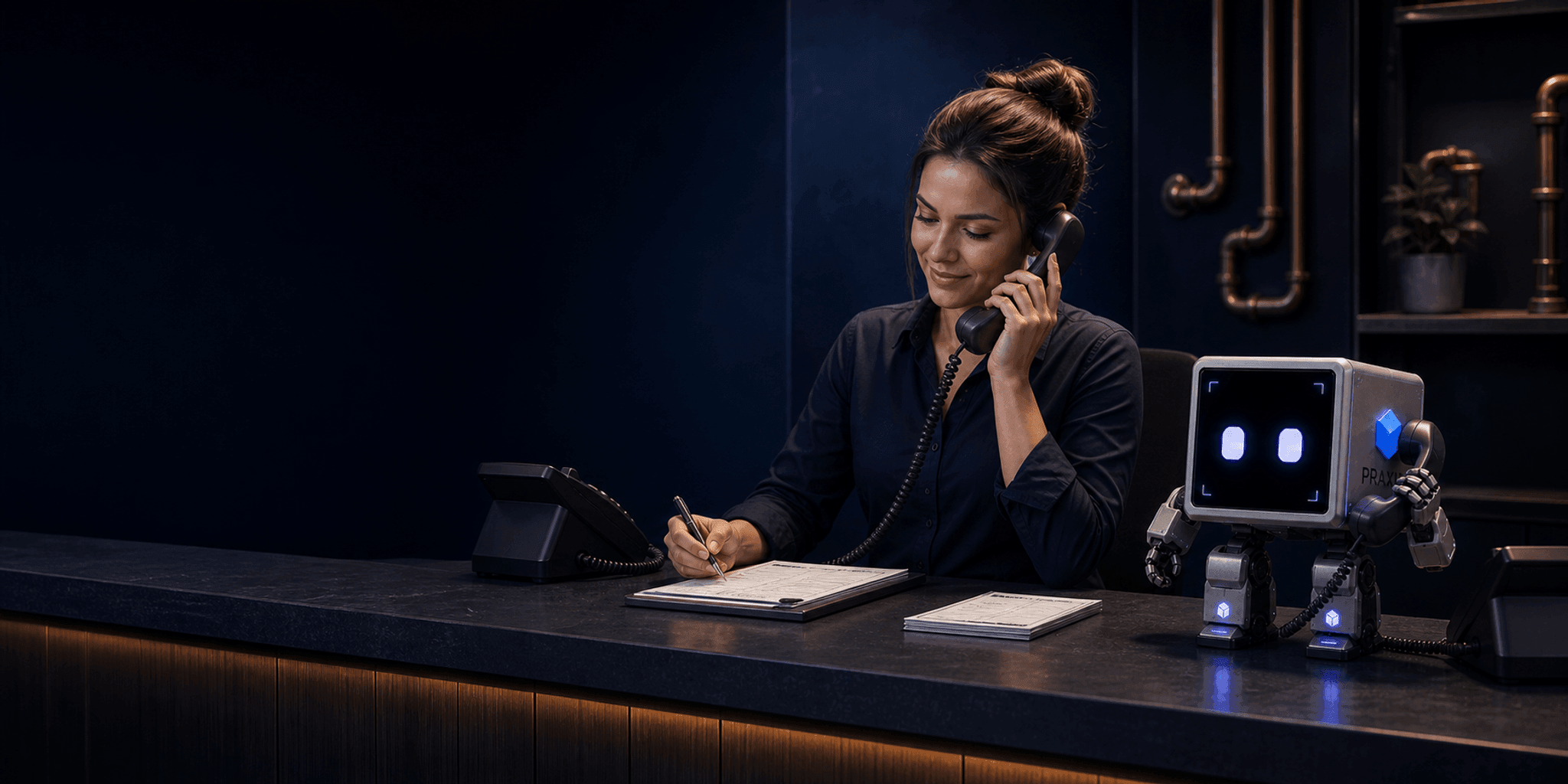
Plumbers · Buying decision · 2026
The short answer
Choose AI when the problem is reliable phone cover. Hire a human receptionist when the role includes wider administration, judgement-heavy conversations or physical office work.
Best for immediate answering, structured qualification and predictable cover across busy periods.
Best when the role includes supplier calls, customer care, diary judgement and broader office ownership.
Let AI handle repetitive first contact while a person owns exceptions and the wider office role.
An AI receptionist is usually the better fit when a plumbing business needs reliable phone coverage, including overflow and out-of-hours enquiries. Hiring a human receptionist makes more sense when the role includes wider office administration, judgement-heavy conversations or physical tasks.
The right choice depends on whether you have a phone-cover problem, a staffing problem or both. AI can answer, qualify, route and book repeatable enquiries using rules you approve; a person can also chase invoices, coordinate engineers, deal with suppliers and own exceptions that need judgement.
For most sole traders and small plumbing firms in 2026, employing someone full time costs roughly £28,000-£40,000 a year once employer National Insurance, pension and optional cover are considered. A growing firm with an administrator or dispatcher already in place may get the best result by combining human judgement with AI first response.
A person can answer calls, manage unusual situations and take responsibility for work beyond the phone.
An automated assistant answers immediately and handles repeatable enquiry work using your rules.
This is the question almost every comparison skips, and it decides whether you should spend on AI or on a salary.
Calls ring out while you are under a sink, enquiries arrive after hours, and several people call at once on a busy Monday. You are losing jobs you already earned the right to win because nobody picked up.
Invoices are not being chased, suppliers need coordinating, engineers need rescheduling, landlords need managing, complaints need human care, and someone needs to be physically present in the office.
An AI receptionist solves the first problem extremely well and the second one not at all. It answers, qualifies, routes and can book according to your connected setup. It does not chase late payment or talk a frustrated commercial client down over twenty minutes.
If you mostly need the phone answered properly, a £30,000 salary is an expensive way to buy coverage. If you need a genuine office person who happens to answer calls too, AI will not replace them, though it can take the phone load off so they get real work done.
Compare the work each option can own before comparing price. The right answer depends on coverage, workload, judgement and the wider role.
Human receptionist
Can own calls plus supplier, customer and administrative work during agreed working hours.AI receptionist
Focuses on repeatable enquiry handling and can provide continuous cover when configured.What this means Do not hire a whole role to solve only a ringing-phone problem.
Human receptionist
One person handles one live conversation at a time.AI receptionist
Can handle simultaneous demand within the configured capacity.What this means AI has the advantage where bursts and overflow are the main constraint.
Human receptionist
Adapts naturally to sensitive, unusual or emotionally complex conversations.AI receptionist
Applies configured rules consistently and escalates outside them.What this means Open-ended judgement still favours a capable person.
Human receptionist
Salary is only part of hiring, alongside National Insurance, pension, equipment and optional cover.AI receptionist
Include setup, integrations, monitoring and the ongoing service fee.What this means Compare the total annual operating cost of each option.
Human receptionist
The person owns exceptions and the wider office function.AI receptionist
AI absorbs routine first contact and out-of-hours volume.What this means The strongest answer may divide the work instead of choosing one side.
| Factor | Employed receptionist | AI receptionist |
|---|---|---|
| Typical annual cost | ~£28,000-£40,000 all-in for one full-time employee | Setup plus subscription; scales with the configured workflow |
| Hours covered | Contracted hours, usually weekdays | Can answer 24/7, including nights and weekends |
| Simultaneous calls | One conversation at a time | Several callers at once |
| Sick days and leave | Phone uncovered unless someone covers | No personal absence, though outages still need a fallback |
| Office admin | Yes: paperwork, suppliers, complaints and office tasks | No: calls, qualification, routing and booking only |
| Recruitment and training | Advertising, interviews and weeks of onboarding | Configuration, testing and launch |
| Unusual judgement calls | Strong | Best on clear, repeatable enquiries with human escalation |
| Reporting | Manual notes unless systems are disciplined | Structured call summaries and booking records |
The salary is never the real number. For the 2026/27 tax year, the cost builds from wage, employer National Insurance, pension, optional cover and recruitment.
Salary platforms vary. Indeed reports UK receptionist pay around £31,500, Glassdoor around £24,300, and Reed listings can sit in the mid-to-high £20,000s. Treat the market as broadly mid-£20,000s to low-£30,000s depending on hours, location and duties.
From 1 April 2026, the National Living Wage for workers aged 21 and over is £12.71 per hour. At 38 hours a week, that is about £25,115 before employer costs; at 40 hours, about £26,437.
For 2026/27, employer NI is generally 15% on earnings above the £5,000 Secondary Threshold. On a £28,000 salary, that is roughly £3,450 on top of the wage.
Auto-enrolment usually requires a minimum employer contribution of 3% of qualifying earnings. With the lower qualifying-earnings level at £6,240, that is around £650 a year on a typical receptionist salary.
| Scenario | Base salary | Employer NI | Min. pension | Direct annual cost | + optional holiday cover | Total with cover |
|---|---|---|---|---|---|---|
| 38-hour minimum-wage floor | £25,115 | £3,017 | £566 | £28,699 | £2,705 | £31,403 |
| Illustrative mid-case | £28,000 | £3,450 | £653 | £32,103 | £3,015 | £35,118 |
| Indeed market-average case | ~£31,500 | ~£3,980 | ~£760 | ~£36,300 | ~£3,400 | ~£39,700 |
A realistic all-in cost for one full-time receptionist sits around £28,700-£39,700 a year before recruitment, equipment or software, and that buys contracted weekday hours rather than 24/7 coverage.
Praxum is £1,200 to set up plus £450 per month, making the first year £6,600 at the current price.
From year two, the current monthly rate totals £5,400 per year, subject to any agreed change in scope or pricing.
Phone answering, qualification, routing and booking—not a human employee’s wider administration or physical office work.
Compared with the employment scenarios above, Praxum is roughly 77%-83% less in the first year for the defined enquiry-handling work. That is a cost comparison between different operating models, not a claim that AI replaces every responsibility of an employed receptionist.
An AI receptionist like Praxum is built to handle the calls a busy plumber cannot get to. For a trade business, that means:
The point is not to replace an office person. It is to stop good enquiries leaking away when you are too busy to answer, protecting demand you already paid to generate through your van, reviews, Google presence and lead platforms.
A capable employed receptionist does plenty that no call-handling AI can do properly:
If your business needs that, you need a person. The mistake is buying a person only to answer the phone, or buying AI when you actually need an administrator.
| Factor | Human receptionist | AI receptionist |
|---|---|---|
| Cost | Salary plus employer NI, pension and cover | Subscription plus setup; varies by provider and workflow |
| Hours | Contracted hours, usually weekdays | Can run continuously when configured |
| Simultaneous calls | One at a time | Several at once |
| Sick days | Phone uncovered unless covered | No personal sickness, though systems can still fail |
| Annual leave | 5.6 weeks paid; cover may be needed | None |
| Recruitment | Adverts, interviews and possible agency fees | Vendor setup and configuration |
| Training | Learns your business over weeks | Rules and scripts configured and tested up front |
| Scaling for peaks | Usually means another hire or temporary cover | Extra volume is easier to absorb |
| Empathy and judgement | Strong on complex or emotional calls | Best on clear, repeatable enquiries |
| In-office work | Yes | No: calls, qualification, routing and booking only |
An employed receptionist is asleep. AI answers, recognises urgency, captures the address, checks service area and routes or alerts according to your escalation rules. Winner: AI, because this is after-hours coverage.
A single receptionist can only take one conversation. AI can answer all three, qualify each and move suitable enquiries towards booking. Winner: AI, on concurrency alone.
A managing agent is unhappy about disputed invoices across several properties. That needs tone, account memory, negotiation and follow-up. Winner: human, with AI escalating rather than guessing.
Choose AI first when the job is mainly coverage, capture and qualification:
For a one-van business, see AI call answering for sole trader plumbers. For busy daytime call spikes, see overflow call answering for plumbers.
Hire a person when the role is broader than answering calls:
A hybrid suits growing plumbing firms where there is already a dispatcher, administrator or office owner handling exceptions.
It answers, qualifies, checks postcode, captures job detail, books where configured and catches overflow.
Complaints, commercial accounts, awkward schedule changes and exceptions stay with the human who understands the business.
Calls are not lost just because the office is closed, and routine enquiries can be held for business hours.
Your skilled admin stops drowning in repetitive calls and gets back to work that actually needs them.
Ignore generic claims like "every missed call is worth £500." Use your own numbers. The honest way to value missed calls is:
To compare options, work out how many extra jobs each choice needs to pay for itself:
For example, if employing someone all-in costs about £32,000 a year and your average job earns £180 gross profit, that role needs roughly 178 extra booked jobs a year to justify itself on calls alone: around 3-4 a week.
If most of those jobs are routine bookings AI could capture, the maths starts to favour AI plus your own time. Use the missed calls calculator before committing to either route.
AI is not magic, and a trustworthy comparison says so. Watch for misunderstood callers, integration errors, outages and over-automation around safety-critical calls.
Run emergency, routine, existing-job and out-of-area calls before launch.
Decide exactly who receives calls or alerts when the AI cannot handle something confidently.
Check postcodes, job types and minimum work rules so the system does not book work you would reject.
Make sure availability, calendar rules and confirmations work before live calls reach customers.
Gas and serious leak reports need approved wording and immediate human routing where appropriate.
Caller disclosure, lawful basis, transparency, minimisation, recordings and retention rules need to be agreed at setup.
For UK businesses processing caller information, read ICO guidance on lawful basis and right to be informed. This page gives practical business comparison, not legal advice.
| Your business | Best starting model | Why |
|---|---|---|
| Sole trader / 1-3 engineers | AI-first | Reliable phone coverage without funding a broad office role |
| 4-10 engineers | AI + existing admin | AI handles first response and peaks; your person manages exceptions |
| Growing multi-team firm | Hybrid | Volume justifies automation plus human supervision |
| Needs full-time office coordination | Human, supported by AI | The employee adds value well beyond answering calls |
| High-volume repetitive enquiries | AI front line + human escalation | Automation handles standard flows; humans keep the judgement work |
For pure phone coverage, usually yes. A full-time UK receptionist costs roughly £28,000-£40,000 all-in once employer NI, pension and cover are considered, for contracted hours only. AI runs on setup plus subscription pricing and can cover nights, weekends and simultaneous calls. The exception is when you need genuine office administration.
Continue comparing