Choose an AI receptionist when speed matters most.
Best for frequent missed calls, after-hours demand and enquiries that should be qualified or booked immediately.
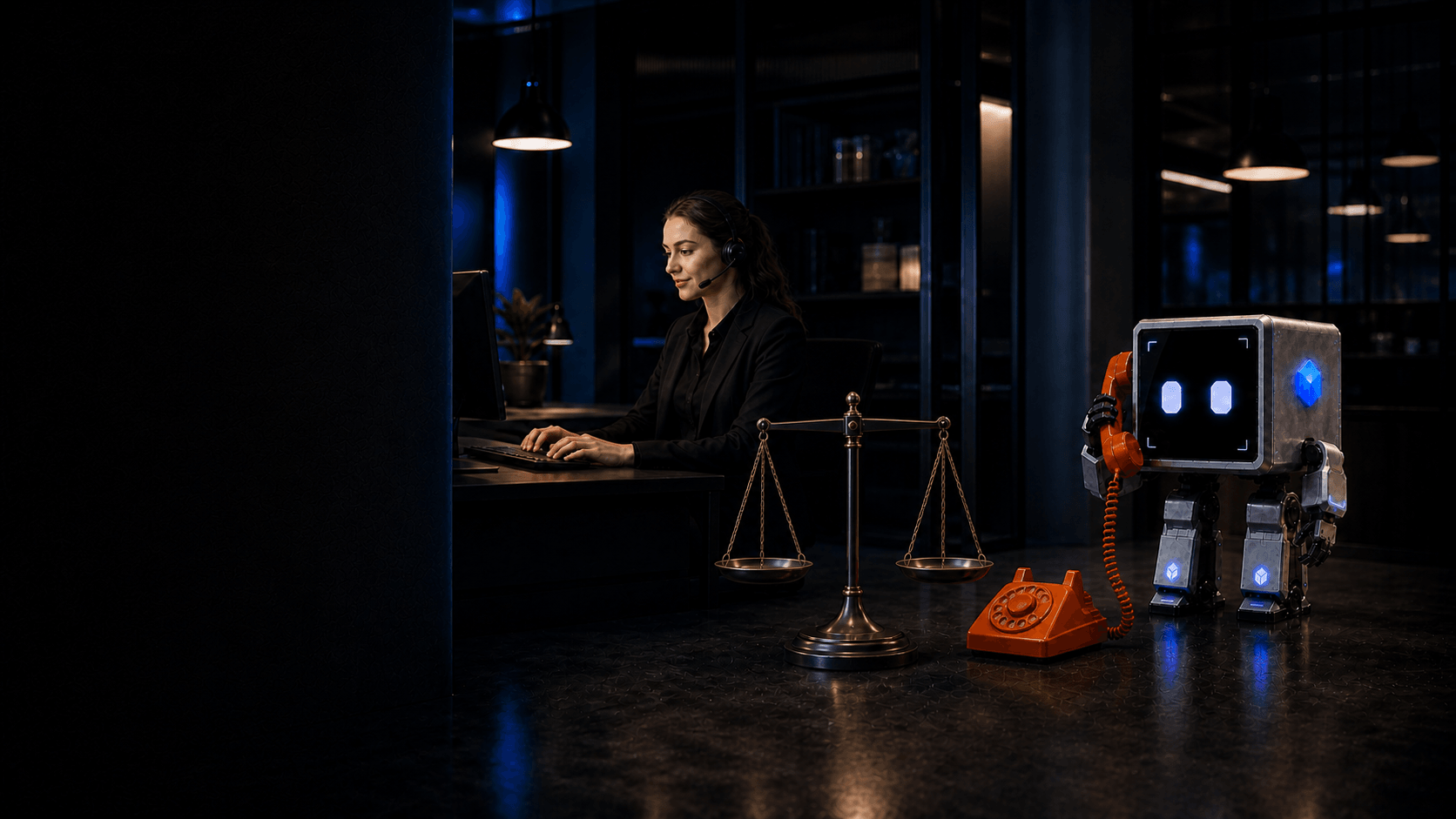
Buyer’s guide · UK trades
The short answer
Choose AI for speed, people for nuance, or combine both when different calls need different handling.
Best for frequent missed calls, after-hours demand and enquiries that should be qualified or booked immediately.
Best for lower call volumes or conversations that are complex, emotional or difficult to reduce to clear rules.
Let AI handle routine, time-sensitive enquiries and escalate unusual or sensitive calls to a person.
A practical comparison for plumbers, heating engineers, electricians and other trades deciding how to stop losing jobs to missed calls.
A call answering service routes your missed calls to a remote human who takes a message and asks the caller to expect a callback. An AI receptionist answers in seconds, qualifies the enquiry, and can text the caller, capture the job details and book or hold a slot on the same call, with no callback to chase later.
For most UK trades the deciding factors are not "human vs robot". They are three practical things: what happens to the call when you are on a roof or under a sink, whether the caller is dealt with in seconds or hours, and whether whoever answers actually understands a trade enquiry. This guide weighs both options against those tests fairly, including where a human service is the better buy.
A person answers in your business name, takes a message and adapts naturally when the conversation becomes unusual.
An automated assistant answers immediately, qualifies the enquiry and can book, message or escalate using your rules.
A call answering service diverts your calls to a remote operator, usually in a shared call centre handling lines for many businesses at once. When you cannot pick up, they greet the caller in your business name, take their name, number and a short note about the job, and promise a callback. Better plans follow a script you provide and can answer simple questions about your hours or coverage.
What varies between providers is depth. Basic plans are built around message-taking. More advanced virtual receptionist services can access a diary and book an appointment when you give them calendar access and clear booking rules. So the honest line is not "they can never book". It is that the further you go, the more it tends to cost, and message-and-callback is still the default at the lighter end. Either way, every message becomes a callback task waiting for you. For the pricing side, see plumber answering service costs in the UK.
An AI receptionist answers automatically the moment a call is not picked up. Instead of reading a fixed menu, it understands what the caller is asking, replies in natural language, and takes structured action: it captures the job details, asks qualifying questions ("Is this a leak right now, or a quote for later?"), sends a text or WhatsApp message, and books or holds a slot. It does this around the clock, and it can usually take more than one call at once, subject to the provider’s plan and capacity.
The weakness to be honest about: AI handles common, structured enquiries very well, but a genuinely unusual or emotionally charged call is still better with a person. A well-set-up system knows when to escalate to you instead of pushing through.
Watch this term when you compare providers. "Virtual receptionist" can mean a remote human, an AI system, or a hybrid of the two, depending on who is selling it. Always check which one you are actually buying before you compare prices or features.
The points that change the outcome for a trade business—without a wall of specifications.
Call answering service
Usually fast, although callers can queue behind other clients at busy times.AI receptionist
Answers in seconds and can handle several calls at once, within the chosen plan.What this means If several calls land together, AI removes the queue; otherwise both can answer quickly.
Call answering service
Most services leave a clear message and a callback task for your team.AI receptionist
Can leave a qualified enquiry, booked slot or agreed next step.What this means Choose based on whether you need a message or a completed next step.
Call answering service
A person adapts naturally, but a shared script may have limited trade context.AI receptionist
Can apply your service area, urgency and booking rules consistently.What this means A trained person handles the unexpected; configured AI handles repeatable rules consistently.
Call answering service
Strongest for emotional, sensitive or unusually complex conversations.AI receptionist
Best when it recognises the edge case and hands it to a person cleanly.What this means Sensitive calls need a person, whether they start with one or are escalated to one.
Call answering service
Look beyond the base fee to calls, minutes and after-hours premiums.AI receptionist
Check allowances, integrations and overage—then compare cost per job won.What this means Compare the cost of a useful outcome, not the cheapest monthly headline.
| Capability | Call answering service | AI receptionist |
|---|---|---|
| Who answers | Remote human operator, usually shared across many businesses | Automated voice agent dedicated to your line |
| Speed to answer | Usually quick, but can queue behind other clients’ calls at peak | Usually answers in seconds and can take several calls at once, subject to the provider’s plan and capacity |
| Availability | Often 24/7 depending on tier; after-hours may cost more | 24/7, with after-hours included on most plans |
| Books or changes the job on the call | Varies: basic plans take a message; some book with calendar access and clear rules | Can qualify, then book, hold or reschedule a slot when integrated with your diary |
| Trade-specific triage (emergency vs quote) | Limited: generic script, little trade context | Can be configured to sort an emergency from a quote and act differently for each |
| Text / WhatsApp follow-up | Rare: usually a phone message only | Yes: can send a link, capture details and continue by message |
| Complex or emotional calls | Strong: a person adapts and reassures | Weaker on nuance; should escalate to you |
| Human escalation | The whole call is already human | Routes or hands off to you when a call needs a person |
| Consistency | Varies by operator and shift | Follows the same qualification and routing rules every call (wording varies naturally) |
| Pricing model | Monthly fee and/or per-call or per-minute; after-hours premiums common | Usually a monthly plan; may include call or usage limits, overage or setup. Models vary |
| Best fit for | Low volume, or wanting a human voice on every call | Trades losing jobs to missed calls who want enquiries captured, qualified and followed up fast |
Pricing varies widely on both sides, and the headline figure is the least useful number. You will find monthly packages, per-call and per-minute charges, and bundled allowances across both categories, so do not assume a human service is always "usage-based" and AI is always "fixed". Both models exist for both.
When you compare quotes, line these up instead:
That last line is the real comparison. A cheaper service that only takes messages can cost more per job won, because the booking still depends on you ringing back in time.
Most "AI receptionist vs answering service" comparisons are written for salons, clinics and US offices. Trades are different, and three things matter more than the generic comparison admits.
Someone with a leak is not filling in a web form. They are ringing numbers in order until someone useful answers. Whoever responds first, clearly, usually wins the job. Message-and-callback loses to instant response here.
For a plumber, the first job is not to book. It is to sort the emergency-now caller from the quote-next-month caller. A generic operator reading a script cannot do that well. Trade-specific triage is where a properly configured system earns its place.
This is why text and WhatsApp follow-up beats a stack of voicemail messages: the enquiry lands in writing, details captured, ready to action when your hands are free. We cover this on our WhatsApp booking system for plumbers page.
Same caller, two set-ups.
The operator answers, takes the caller’s name, number and "water’s coming through the ceiling", and sends you a message. You see it when you are off the job and call back, by which point the caller may already have someone on the way.
The call is answered straight away. It checks whether water is actively escaping, takes the postcode, confirms it is in your service area, captures the property and job details, asks the caller to send a photo on WhatsApp, and either flags the emergency to you immediately or offers the right next step.
One honest limit: distressed callers, safeguarding concerns, disputes, vulnerable customers and unusual safety situations may need a person straight away. A good system escalates those rather than handling them, and it should never give plumbing, gas or electrical safety advice beyond its agreed script.
Whatever you are leaning towards, ring it yourself and run these five trade calls. They expose more in ten minutes than any sales page:
While you are on, judge: urgency detection, postcode and service-area checks, how it handles interruptions, your accent and background noise, whether it confirms details back to you, whether it books into a real diary, whether it escalates to a human cleanly, and whether it follows up in writing. Most telling of all: what it does when it does not know the answer. A good system says so and escalates. A weak one guesses.
A human answering service is the right call when:
An AI receptionist tends to win when:
For a lot of trades the smartest answer is not one or the other. It is both, arranged around how you work. Common set-ups:
The phone is covered evenings and weekends; you take the calls you can during the day.
AI handles the routine enquiry and routes anything unusual or sensitive to you or a colleague.
Calls roll to AI only when your line is already busy, so nothing rings out.
A person answers where you want the human touch, with AI catching what they miss.
A hybrid makes sense when your calls split clearly into "routine and time-sensitive" (well suited to AI) and "complex or emotional" (better with a person). You do not have to pick a side on day one. Start with after-hours cover, see what it catches, and expand from there.
This is the part US-focused comparisons skip, and it is worth getting right. Any system that records calls, captures caller details, or follows up by text or WhatsApp is processing personal data, which brings UK GDPR duties: having a lawful basis, being clear with people about what you do with their data, and not keeping it longer than you need.
It helps to separate two things:
Confirming an appointment, answering the enquiry the caller made, sending details they asked for, continuing a conversation the customer started. This is part of dealing with their request.
Promotional follow-ups, future offers, unrequested sales messages, and campaigns by SMS or WhatsApp. Marketing messages are covered by PECR as well as UK GDPR, and generally need consent. That is separate from simply replying to an enquiry the customer made.
If you record calls, you would typically need an appropriate lawful basis, transparency that recording happens and why, a clear purpose, sensible retention (not "keep forever"), proper access and security controls, and respect for callers’ rights over their data.
None of this is a reason to avoid either option. Human and AI providers handle it routinely. But whichever you choose, ask plainly: where is caller data stored, who can access it, and how is consent handled for any follow-up messaging? For the current detail, read the ICO’s guidance on lawful basis and direct marketing and PECR directly. Guidance changes, so rely on the source rather than a vendor’s summary. This is general information, not legal advice: assess your own processing activities and take professional advice where you need it.
Praxum is an AI receptionist built for UK trades, so we have a stake in this comparison. We have kept it honest: where a human service fits better, we have said so above.
Praxum is a managed AI receptionist service for UK businesses, not a general answering service or a chatbot bolted onto a website. It is built around the parts of the job that decide whether a trade business wins or loses an enquiry:
When you do not pick up, Praxum answers rather than letting it ring out to voicemail, because for trades, the missed call is where the job is lost.
It is set up to tell an emergency apart from a quote request and handle each differently, instead of reading one generic script at every caller.
Postcode and service-area checks, the property and job details, and the questions you would ask yourself.
It can follow up by text or WhatsApp, so the enquiry lands captured and ready to action when your hands are free.
And escalates to you when a call needs a person.
Done-for-you configuration around how your business actually runs, with a clear summary of every call so you know what came in while you were working.
Praxum follows the same qualification, routing and escalation rules on every call, so you always know what a caller experiences, even though the exact wording varies naturally from one conversation to the next. The goal is not to replace you or to "automate everything". It is to stop good enquiries slipping away when you are too busy to answer, and to make sure the caller is dealt with properly while they are still interested. See how it fits a one-person business on our AI answering service for sole traders page, or start with the plumbing overview.
A call answering service usually uses a remote human to take a message and request a callback. An AI receptionist answers automatically, understands the enquiry, qualifies it, and can book or follow up by text or WhatsApp without a callback queue. The practical difference is whether you get a message to action later, or a job already captured and qualified.
Continue comparing